Jul 17 2008
Alaska, the final frontier
Rachel, Sasha, and I went to Alaska two weeks ago for a family vacation with Rachel’s family. Rachel’s dad had a meeting in a small town south of Anchorage called Girdwood, at a resort called the Alyeska resort. The resort is located at the southern edge of the Chugach State Park, which is home to the legendary Chugach mountains and to some of the best skiing in the world. As such, I was totally excited about going on this trip, mainly because Girdwood is home to the Chugach Powder Guides, some of the best heli-skiing guides in the nation. They are always featured on the Warren Miller films. So, it is one of my dream vacations to go up there and heli-ski for a week with a few close ski buddies. It is crazy expensive though, around $6000. Rachel says that might be a good 40th birthday gift. We’ll see. 
I’m not going to go into incredible detail in this post, because I don’t really have time to write an epic tale of our trek to Alaska, so here is, in a nutshell, what we did. We got onto a non-stop flight in San Francisco and were in Anchorage 4.5 hours later. This was Sasha’s first flight, and she did really well on it. Her ears didn’t bother her and she was cute and fascinated by the whole experience, not to mention that the stewardesses loved her. Anyway, we got to Anchorage at around 11:30pm, and the sun had just set (yes, the sun is up for 19.5 hours this time of year, and it never really gets dark). So, that was kind of strange, but really cool. The weather looked a lot like San Francisco in the summer time, 50’s and 60’s with fog everywhere, with the addition of giant mountains all over the place. We drove to Girdwood where we shacked up in a three bedroom cabin with Rachel’s folks and her brother and his wife. It was very nice and had a hot tub (win!) that I never got to use (fail). Sleeping for Rachel and I was fairly easy with it being light all night long because we’re both pretty used to no schedule with Sasha, so it was all normal to us.
The next day we headed up to the hotel Alyeska to check things out and get some lunch (once we all got moving again). The hotel was nice, but a lot smaller than it seems in the pictures. Also, we found out that it is a $300/night place (!!!). I can tell you that it didn’t seem worth that to me. Anyway, we hung out walked around, had the WORST service I’ve ever had at a restaurant anywhere in the world while trying to have lunch, then tried to avoid the rain for awhile before heading off to a wildlife preserve to see moose, elk, bison, musk oxen, and black bears. The wildlife preserve was nice, but we spent a lot of the time trying to avoid the rain. Yes, it rained almost the entire time we were there, endlessly. It would have been nice to know before we went to Alaska that Girdwood is the most northerly rain forest in the world. That’s right, a rain forest! I suppose that explains why they get 65 feet of snow every year (905″ last year), and thus the legendary snow.
Anyway, trying once again to keep this post short and sweet, we went to the thriving metropolis of Whittier, and caught a tour boat that took us around Prince William Sound to see the Blackstone glacier. It was pretty remarkable, and the ship got pretty close up to the head of it (check out pictures in our Photo journal). Sasha liked the boat ride as well and really enjoyed trying to watch the white water crest off of the side of the boat as we went on our way. We also took a train tour up into the mountains on another glacier tour. This was fun because we got to hang out on a real train, also a first for Sasha. It was a nice tour, lots of sights, wildlife, and mountains, which I love. The next day, the sun came out and Rachel and I went on a six mile hike all the way across the valley and back, which took us to a gorge that we had to cross using a hand-tram, which was WAY cool:
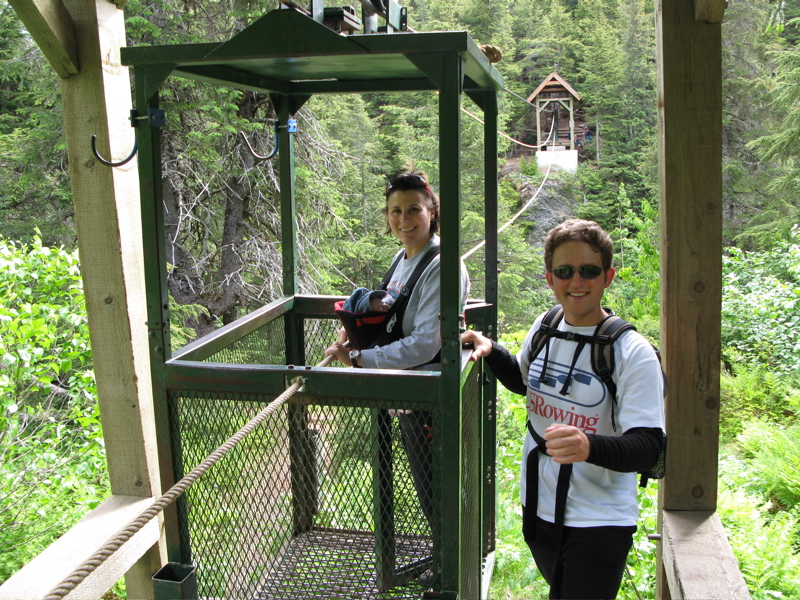
This was a really fun hike, except for the swarms of mosquitoes that attacked us every time we stopped for 10 seconds.
Probably the coolest thing that the group did in Alaska, that I didn’t get to do because I volunteered for Sasha duty, was take a helicopter ride up to the top of a glacier and ride Iditarod sleds around while seeing how the dogs are trained during the summer for the race next spring. Rachel said the dogs were really cool, but not what she expected and that Hollyweird had really done a number on what people would expect the dogs to look like. These dogs were true Alaskan Malmutes. The dogs used in the movies are Siberian Huskies, definitely prettier dogs than the mutt that is the Malmute. She said they were all different shapes, sizes and colors and that they were skinny and in great shape. There are some great pictures of it in our photos section. Anyway, Rachel and Co. got to ride around the glacier on the dog sleds, and they said that it was really fun. One of the most remarkable things was that, once a team of dogs got hooked up to a sled all 100 or so dogs started to go nuts and got really excited, jumping around and barking because they knew a team was about to go out. She said that dogs were really cute and it was really cool experience. I’m a little sad that I missed it, but I have to admit that nothing quite beats being able to spend four hours with my daughter, just the two of us.
Finally, we got to go to the top of Mount Alyeska for dinner one night (taking the tram). The view from up there was really pretty, but it totally made me want to go skiing. I almost can’t help being at a ski resort and not ski. The restaurant was a four diamond restaurant, something virtually unheard of in Alaska. The food was very good and the service was, for once, excellent. The best part was, of course, the view. You could see the entire valley and a lot of Turnagain Arm, the inlet from Chickaloon bay that leads from the ocean to Anchorage in southern Alaska.
The next day we left. We headed out through Anchorage again and were about an hour delayed leaving because they realized, after we were on the plane, that the plane had a flat tire. So, with everyone on board, they jacked up the side of the plane and replaced the tire. This of course was done by a half-wit, one competent guy and a dog, so it took about an hour to complete the project, while we were sitting on the plane with a restless baby and 300 fisherman fresh of the boat, and I do mean fresh! It did not smell very good in there. One we got into the air, we headed for Seattle. We got there just in time to make our connection to San Francisco, so we ran off of the plane and onto the next one, which was thankfully only one gate away. We sat down and they announced a 45 minute delay imposed by SFO because of excessive smoke in the area from all of th forest fires. So, we sat again until the plane finally took off. All-in-all, it took us around 7 hours to get home. Sasha’s schedule was a mess and so there wasn’t much sleep to be had that night by any of us. We learned very quickly that if were flying with Sasha at this age, that we really need to spring for the non-stop flights. They go much more smoothly.
So, my impression of Alaska is that the entire place is just majestic, extreme and virtually untouched by the influences of modern society. In fact, it kind of reminded me of being in nowhere middle America, where there is nothing but grassland and the occasional redneck on a tractor going to his neighbors to share they cow they just slaughtered. The people were very simple, not too bright, and totally unaware of things like conservation and preservation. I suppose that since the human population in Alaska is so sparse, they figure that the impact the people will have there isn’t that great, so why conserve or try to keep Alaska in its current state? Alaska is beautiful, the glaciers are amazing, the mountains are incredible, the weather this time of year in Girdwood sucks. Alaska is the type of place that outdoorsman would love. It is a haven for fishermen and hunters and back country skiers and hikers. It really isn’t the place to go have a luxurious vacation. If your idea of a great vacation is to sit on a warm beach somewhere sipping Mai Tais, don’t go to Alaska. If you’re a fan of natural beauty of all sorts, even if it is cold and wet, then you’ll love it there and you should go check it out. I loved it, I think it was a great experience for Sasha, and I think Rachel has checked it off of her list. Go figure.
2 Responses to “Alaska, the final frontier”
Leave a Reply
You must be logged in to post a comment.

The Iditarod is terribly cruel to dogs. For the facts, visit the Sled Dog Action Coalition website, http://www.helpsleddogs.org.
Here’s a short list of what happens to the dogs during the race: death, paralysis, frostbite of the penis and scrotum, bleeding ulcers, bloody diarrhea, lung damage, pneumonia, ruptured discs, viral diseases, broken bones, torn muscles and tendons, vomiting, hypothermia, sprains, fur loss, broken teeth, torn footpads and anemia.
At least 136 dogs have died in the Iditarod. There is no official count of dog deaths available for the race’s early years. In “WinterDance: the Fine Madness of Running the Iditarod,” a nonfiction book, Gary Paulsen describes witnessing an Iditarod musher brutally kicking a dog to death during the race. He wrote, “All the time he was kicking the dog. Not with the imprecision of anger, the kicks, not kicks to match his rage but aimed, clinical vicious kicks. Kicks meant to hurt deeply, to cause serious injury. Kicks meant to kill.”
Causes of death have also included strangulation in towlines, internal hemorrhaging after being gouged by a sled, liver injury, heart failure, and pneumonia. “Sudden death” and “external myopathy,” a fatal condition in which a dog’s muscles and organs deteriorate during extreme or prolonged exercise, have also occurred. The 1976 Iditarod winner, Jerry Riley, was accused of striking his dog with a snow hook (a large, sharp and heavy metal claw). In 1996, one of Rick Swenson’s dogs died while he mushed his team through waist-deep water and ice. The Iditarod Trail Committee banned both mushers from the race but later reinstated them. In many states these incidents would be considered animal cruelty. Swenson is now on the Iditarod Board of Directors.
In the 2001 Iditarod, a sick dog was sent to a prison to be cared for by inmates and received no veterinary care. He was chained up in the cold and died. Another dog died by suffocating on his own vomit.
No one knows how many dogs die in training or after the race each year.
On average, 53 percent of the dogs who start the race do not make it across the finish line. According to a report published in the American Journal of Respiratory and Critical Care Medicine, of those who do cross, 81 percent have lung damage. A report published in the Journal of Veterinary Internal Medicine said that 61 percent of the dogs who finish the Iditarod have ulcers versus zero percent pre-race.
Tom Classen, retired Air Force colonel and Alaskan resident for over 40 years, tells us that the dogs are beaten into submission:
“They’ve had the hell beaten out of them.” “You don’t just whisper into their ears, ‘OK, stand there until I tell you to run like the devil.’ They understand one thing: a beating. These dogs are beaten into submission the same way elephants are trained for a circus. The mushers will deny it. And you know what? They are all lying.” -USA Today, March 3, 2000 in Jon Saraceno’s column
Beatings and whippings are common. Jim Welch says in his book Speed Mushing Manual, “I heard one highly respected [sled dog] driver once state that “‘Alaskans like the kind of dog they can beat on.’” “Nagging a dog team is cruel and ineffective…A training device such as a whip is not cruel at all but is effective.” “It is a common training device in use among dog mushers…A whip is a very humane training tool.”
During the 2007 Iditarod, eyewitnesses reported that musher Ramy Brooks kicked, punched and beat his dogs with a ski pole and a chain. Brooks admitted to hitting his dogs with a wooden trail marker when they refused to run. The Iditarod Trail Committee suspended Brooks for two years, but only for the actions he admitted. By ignoring eyewitness accounts, the Iditarod encouraged animal abuse. When mushers know that eyewitness accounts will be disregarded, they are more likely to hurt their dogs and lie about it later.
Mushers believe in “culling” or killing unwanted dogs, including puppies. Many dogs who are permanently disabled in the Iditarod, or who are unwanted for any reason, are killed with a shot to the head, dragged or clubbed to death. “On-going cruelty is the law of many dog lots. Dogs are clubbed with baseball bats and if they don’t pull are dragged to death in harnesses…..” wrote Alaskan Mike Cranford in an article for Alaska’s Bush Blade Newspaper (March, 2000).
Jon Saraceno wrote in his March 3, 2000 column in USA Today, “He [Colonel Tom Classen] confirmed dog beatings and far worse. Like starving dogs to maintain their most advantageous racing weight. Skinning them to make mittens. Or dragging them to their death.”
The Iditarod, with its history of abuse, could not be legally held in many states, because doing so would violate animal cruelty laws.
Iditarod administrators promote the race as a commemoration of sled dogs saving the children of Nome by bringing diphtheria serum from Anchorage in 1925. However, the co-founder of the Iditarod, Dorothy Page, said the race was not established to honor the sled drivers and dogs who carried the serum. In fact, 600 miles of this serum delivery was done by train and the other half was done by dogs running in relays, with no dog running over 100 miles. This isn’t anything like the Iditarod.
The race has led to the proliferation of horrific dog kennels in which the dogs are treated very cruelly. Many kennels have over 100 dogs and some have as many as 200. It is standard for the dogs to spend their entire lives outside tethered to metal chains that can be as short as four feet long. In 1997 the United States Department of Agriculture determined that the tethering of dogs was inhumane and not in the animals’ best interests. The chaining of dogs as a primary means of enclosure is prohibited in all cases where federal law applies. A dog who is permanently tethered is forced to urinate and defecate where he sleeps, which conflicts with his natural instinct to eliminate away from his living area.
Iditarod dogs are prisoners of abuse.
Sincerely,
Margery Glickman
Sled Dog Action Coalition, http://www.helpsleddogs.org
Ari, for another view of Alaska, check out my friend Carol’s website at http://www.godssleddog.blogspot.com. I think you’ll like it!! Stace