Archive for the 'rowing' Category

Aug 31 2005

Masters National Championships 2005

Published by Ari under rowing

Earlier this August, the competitive rowing teams from the Austin Rowing Club set out to compete on a national level at the US Rowing Masters National Championships in Worcester, MA. We trained long and hard under the direction of head coach George Jenkins, and we expected to hold our own against the extreme level of competitors that live in the northeast. But first, we had to get there.

I don’t think there was a single person who arrived in Boston, New Haven, Manchester, or Providence that arrived on time or on the flight they were supposed to be on. I’m not sure what happened to air travel this week, but it has definitely hit an all time low for reliability and safety, as evidenced by the two recent plane crashes (one in Greece and one in Venezuela). Anyway, our flight out of Austin was canceled abruptly when one of the baggage handlers noticed a tear in the outer hull of the aircraft. While this occurrence was wholly inconvenient, required us to reissue our tickets, and ultimately arrive in Boston three hours late, we were glad that the airplane didn’t rip apart in mid air. Never-the-less, we had planned on arriving in Boston, traveling around, grabbing some dinner and then making our way to the hotel, which was in Framingham, about 20 miles from Boston. But, being that it was 9:30pm and we had to be at the regatta venue at 7:30 the next morning, we got our car and headed straight out of town. It turns out that Framingham exists in a fold in space-time that is nearly impossible to get to from the Mass Pike unless you make a wrong turn and cut through the back lot of a shopping center. Despite this, we managed to find our hotel and got settled in for a quick night’s sleep.

The next morning, we awoke, got dressed in our racing attire, packed up snack food, water and Gatorade, and drove the remaining 30 miles to the official armpit of Massachusetts, Worcester. The regatta took place at Regatta Point on Lake Quinsigamond State Park, the same place where the Eastern Sprints occur, so it is thus a famous venue and they know how to hold regattas. This year, however, was the apparent exception to the rule. There were over 800 boats entered for races during the four day event, and we had a parking lot the size of most McDonald’s restaurants in which to park our trailers, unload our boats, rig them, and store them. Space was impossibly tight and the only place for us to set up camp was on a ridiculous 45 degree incline that we kept falling down on. But, once you were on the water, everything was wonderful. The course was a 1000m, seven lane course that was perfectly designed, complete with extremely straight lanes, nicely designed steakboat platforms (starting platforms), a fixed announcement podium at the start, and a photo finish system that captured video of the close finishes so that titles could be properly awarded. In addition, Lake Quinsigamond had very nice water and relatively low winds compared to some of the venues that we’ve been to. So, while the venue sucked, the course was great, so overall, the regatta was average.

The competition, however, was not average by any stretch of the imagination. Loaded with ex-olympians and collegiate title holders (and the added benefit of hundreds of years of rowing tradition in the northeast), it became apparent that we had our work cut out for us. Everyone was fast. Most boats had perfect form and perfect swing and looked as if they’d been rowing together for 50 years, as some of them had been. So, it was no surprise that we, in our many, many lineups, most of which had only been practiced a few times, had a hard time making it into the finals or medaling in any of the events. The mood of our group quickly turned from defiance to defeat as we struggled to find the lightness of spirit to enjoy the experience, the people we were rowing with, and the beautiful weather we were having. But, events of the day were trying very hard to occlude those feelings.

After a long, and relatively dismal day of 4th, 5th, and 6th place finishes, the mixed doubles heats came up for launch. I was rowing with my wife, and we usually have very nice rows together. This time however, was going to be different. We were out in the warm up area, minding our own business, when another double collided with us out of nowhere. They hit us at full speed on our port side, which means that they were on the wrong side of us. Before we knew what was happening, we both looked around to assess the damage and noticed that Rachel’s oar had been snapped clean in two! This, of course, was her personal set of oars and our race was set to begin in less that 15 minutes. The marshal arrived and helped us retrieve the severed oar blade while the people that hit us told us that the accident was our fault (we were just starting to move from a dead stop) and then proceeded to run away without ever offering to help pay for the damaged oar. So, I had to row the double over to the nearest dock and await replacement oars which were promptly delivered by our club president and savior, Paul Scripko. It was good to see him and it calmed us down from an extremely angry state to a manageable, but agitated one. We also thought that we would certainly miss our race, so we resigned an utter defeat. However, it turned out that they had held our race for us. So, we hurried to the starting line and the race started. This race was not our best 4 minutes, 29 seconds as husband and wife. We were doing OK until around the 500m mark when my favorite hat blew off in the 20 mph head wind and I could do nothing but watch the memories associated with that hat sink most unspectacularly into the black depths of Lake Quinsigamond. The hat loss, just another occurrence against us during this race, broke my concentration for long enough that we lost our hold on one of the other boats. Once we reached the last 250m, I was determined to make up for lost time, so I took up the stroke rating to 36spm, then to 38spm hoping to gain on them again so that we could at least scrape a 5th place finish out of it. But, Rachel was using the club oars, with grips that she wasn’t used to and she was having a hard time controlling them at that speed, and I was exhausted and angry and I wasn’t positioning my body correctly, which was destabilizing the boat. We had to slow down and ultimately finished 6th out of 6 boats, and not advancing to the finals. This race was dismal, but was thankfully the worst row of the race, and it occurred on the first day. The loss of her oars really shook Rachel and it took her a few days to get past it, but in the end all was well. A few of our boats that day did well. The Women’s coxed four came in 3rd with a time of 4:11:85, and Garrett and Melissa came in 3rd in their double with a time of 4:22:96, sending both boats into the finals (see results table below). Two boats also made it into the finals on day two as well. Arch Bell and Paul Scripko came in 3rd in the Men’s B pair and Don Kerth came in 3rd in the Men’s C single.

Wednesday night, we ate dinner in Framingham at this place called Skipjack’s. We settled on this place after spending about an hour driving around the Framingham, Natick area looking for another restaurant called The Naked Fish, which apparently only exists in another universe because we couldn’t find it. Anyway, Skipjack’s was pretty good. Everyone seemed to be in the mood for good seafood (except for Rachel because she hates seafood), and they had plenty of it. We spent about 1.5 hours there and then we finally went back to the hotel to get ready for more races (the pictures from the entire weekend can be found in the Photos section).

Friday was our first day of finals at the regatta and it was another day of hard racing and non-medaling finishes. However, in the middle of the day, Garrett Heifrin and Camille Jobe pulled out a silver medal in the Women’s A pair! It was so nice to finally have a medal for our team, we were all very proud of them and their win called for celebration that night.

So, Friday night we ventured into Boston for a taste of some fantastic Italian food. Boston is well known for many different kinds of food from its legendary Chowdah to its lobster. Boston also has a historic section of town known as the North End. Among other things, this area has some of the most authentic and delicious Italian food you can get in the US. The narrow streets have an extremely European feel to them and you can walk up to most restaurants and peruse their menus to decide if the fare and cost are what you are looking for. Most restaurants are very small and feel like you’ve walked into someone’s home, but the food is always excellent. We had planned on walking a little way into the North End to gander at all the restaurants and take in all of the sights, but we could only get about two blocks into the neighborhood because a sewer fire had caused five manholes to explode, issuing forth flames and sulfuric-smalling smoke. So, we ended up at a little place called Mother Anna’s which is located on the very edge of the North End. Rachel and I had been to this restaurant many years ago and liked it a lot, and it didn’t disappoint again. The food was wonderful, the service was great, and everyone had a great time. On the way back to Framingham, we made a stop on the Boston University Campus for some famous frozen yogurt from Angora’s, a haunt much frequented by Rachel during her tenure as a BU student.

Saturday, the final day of the regatta was by far our most successful day as a team. The day finished out with four of our boats in medaling positions. Two of the boats were bronze medal winners: Don Kerth and Kris Villamin finished with a time of 3:46 in the lightweight Men’s B 2x, and Don Kerth, Kris Villamin, Vince Perez, and Kourt DeHaas finished with a time of 3:32 in the lightweight Men’s A-C 4x. Also, Arch Bell, Tim Jones, Garrett Heifrin, and Camille Jobe finished with a silver medal in the Mixed A 4x with a time of 3:25. Finally, and most notably, our lone gold medal winners were Camille Jobe, Garrett Heifrin, Melissa Gabriel, and Rachel Berman in the Women’s club A 4x with a time of 3:36! We were so proud of all of our medal winners that day for vindicating our rowing club and bringing home the medals. The events of the week were definitely a call for celebration.

So, that night we returned to Boston to eat at a very old restaurant with great lobster called Durgin Park located in Faneuil Hall. We made it to the restaurant right as they were closing the kitchen, and we managed to get the last six lobsters they had in the place. It was a great celebratory dinner complete with a toast to our team and coach, and with lots of wine flowing. Afterward, we started to hit the bars in the Government Center area with a vengeance. Much drinking, dancing, stumbling and hilarity ensued as the night progressed toward last call at 2am (see the pictures section). Then, we gathered everyone up into the two cars we had arrived in, and headed back to our hotel. One car made it back without incident, but the other car was forced to exit the Mass Pike due to some vomiting and bladder issues, which resulted in them getting thoroughly lost in the suburbs of Boston. Finally, around 3:45am, they had found their way back to the hotel, and we all went to sleep, wary of the fact that we were all flying out of Boston early the next morning.

This regatta was by far the most difficult and high level regatta that I’ve ever been to. The competition was stiff and we just simply had not practiced our boats to the point of being able to hold our own with the other crews that were there. I believe that we had the appropriate physical fitness and the ability to do well, but without rowing in lineups that were very well practiced, we didn’t have a chance of catching some of these people. All in all, we had a great time. The people on our team are all wonderful, fun, and supportive people and we always have a great time together. I look forward to future regattas and to being able to compete at a higher level at next year’s Masters National Championship.

Regatta Results for Austin Rowing Club
* – advance to final

Event Time Place Lineup (cox to bow)
Wednesday, 8/10/2005
Womens A 2x-Heat 01 04:22:96 3rd* Garrett Heifrin, Melissa Gabriel
04:33:63 5th Jennifer DeHaas, Rachel Berman
Womens A 2x-Heat 02 04:51:60 5th Linda Santos, Amy McSpadden
Mens C 2x-Heat 03 04:10:86 4th Don Kerth, Paul Scripko
Womens A 4+-Heat 01 04:11:85 3rd* Vince Perez, Camille Jobe, Garrett Heifrin, Amy McSpadden, Rachel Berman
Mixed A 2x-Heat 01 04:13:83 4th Garrett Heifrin, Brian Smith
04:28:41 6th Arch Bell, Amy McSpadden
04:34:67 7th Jennifer DeHaas, Kourt DeHaas
Mixed A 2x-Heat 02 04:29:56 6th Ari Berman, Rachel Berman
Thursday, 8/11/2005
Lt. Mens A 1x-Heat 01 04:00:14 4th Kristoffer Villamin
Mens B 2–Heat 02 03:48:93 3rd* Arch Bell, Paul Scripko
Lt. Mens C 1x-Heat 02 04:02:22 3rd* Don Kerth
Womens C 1x-Heat 01 04:28:71 5th Melissa Gabriel
Womens A 1x-Heat 02 04:34:04 5th Jennifer DeHaas
Lt. Womens A 1x-Heat 01 04:27:82 4th Rachel Berman
Womens B 2x-Heat 01 04:07:86 4th Camille Jobe, Melissa Gabriel
Mixed C 2x-Heat 02 03:56:35 6th Paul Scripko, Melissa Gabriel
Friday, 8/12/2005
Mens Club A-B 4x-Final 03:22:32 4th Arch Bell, Tim Jones, Ari Berman, Kristoffer Villamin
Mens Club C 4x / Mens Club D 4x-Final 03:38:42 6th Don Kerth, Kourt DeHaas, Vince Perez, Paul Scripko
Womens A 2x-Final 04:27:62 5th Garrett Heifrin, Melissa Gabriel
Mens AA 2x-Final 03:58:28 4th Tim Jones, Arch Bell
Womens A 2–Final 04:11:69 2nd Garrett Heifrin, Camille Jobe
Womens A 4+-Final 04:03:80 5th Vince Perez, Camille Jobe, Garrett Heifrin, Amy McSpadden, Rachel Berman
Mens Club A 4+-Final 03:51:38 5th Kourt DeHaas, Arch Bell, Ari Berman, Tim Jones, Kristoffer Villamin
Mixed C 4x-Final 04:23:20 7th Don Kerth, Melissa Gabriel, Linda Santos, Paul Scripko
Saturday, 8/13/2005
Womens AA 2x-Final 04:45:12 6th Linda Santos, Amy McSpadden
Mens B 2–Final 03:51:42 5th Arch Bell, Paul Scripko
Lt. Mens C 1x-Final 04:18:12 6th Don Kerth
Lt. Mens B 2x-Final 03:46:31 3rd Don Kerth, Kristoffer Villamin
Lt. Mens A-C 4x-Final 03:32:70 3rd Don Kerth, Kristoffer Villamin, Vince Perez, Kourt DeHaas
Womens Club A 4x-Final 03:36:92 1st Camille Jobe, Garrett Heifrin, Melissa Gabriel, Rachel Berman
Mixed A 4x-Final 03:25:35 2nd Arch Bell, Tim Jones, Garrett Heifrin, Camille Jobe
03:38:79 4th Ari Berman, Rachel Berman, Jennifer DeHaas, Kourt DeHaas
03:45:37 5th Amy McSpadden, Linda Santos, Vince Perez, Kristoffer Villamin

No responses yet

Aug 08 2005

The Dan Merrick Cup 2005

Published by Ari under rowing

This last weekend, my recreational crew, the Rowtinis, had our chance to test our mettle in a friendly competition with the rest of the recreational crews at the Austin Rowing Club. This race is called the Dan Merrick cup and it is held once a year for the sheer benefit of having the rec crews compete with each other. The Rowtinis have won for the last two years, and we were determined to win this year also. We were a little worried, however, because we were up against an all men’s crew that rows more than once per week, and we only practice on Wednesdays. They were by far our greatest competition, so we had to turn up the intimidation factor.

We always create team shirts to wear during the race, and this year’s design topped them all. It didn’t make any sense, but it was great anyway. Since the main theme for the Rowtinis is that we’re a drinking team with a rowing problem, the image on the front of the shirt depicted a martini glass tipping over and spilling its contents while our Rowtini eight person boat rowed out of the glass and over the spill. The best part is that the boat and its inhabitants were glowing and on fire! The background of the image was a psychedelic mixture of blue and purple and donned the title, “Rowtinis”, in menacing 3D black and shiny letters at the top. As always, each shirt had a letter on the back that, when all eight people were in the boat, spelled rowtinis from stern to bow.

Well, the intimidation seems to have worked. We pulled ahead of the Men’s boat almost immediately and ended up 8 seconds ahead of them at the finish, almost two full boat lengths, and we have three women rowers in our boat! We were at least 30 seconds ahead of all the other boats, which was just kinda sad for them, but they’re new and getting much better every time they row. The second heat, which was more for fun this year, was a little closer of a race. One of the other crews, The Strokes of Genius, were given a 30 second lead on us and the Men’s Wrec crew. We started and immediately had our lead on the Men. But, they were either pulling harder, or we weren’t pulling as hard, because we spent 3/4 of the race stern to bow with them, just barely ahead. Well, we ended up catching up to the Strokes, and pulling ahead of them by 1/2 a boat length, and we took up our stroke rating a bit at the end and pulled ahead of the Men by about one length. It was a much closer race, but we won anyhow. So, for the third year in a row, the Rowtinis have taken the Dan Merrick cup! Does anyone dare defeat us?

No responses yet

Jul 07 2005

Town lake rigor

Published by Ari under rowing

Well, something wholly strange happened to us this morning during our practice on town lake. We began practice at 5:30am as usual. We had two boats out, an 8+ and a 2x (I was in the double with my friend Kris). Today’s workout was to row four 1000m sprints in a row. We started east of I-35 in front of Festival Beach this morning because we have a marked 1000m course over there, making it an ideal location for workouts of this type. It was a hard workout, but we were having a really good row and we were happy with it. After we had completed our third sprint, we headed back under I-35 for our final sprint so that we’d end up near our boat house at the end. Before beginning the last piece, we came to a stop on the west side of I-35 where we took an 8 minute break to let our heart rates recover. Two rowers in singles were rowing east-bound on the south side of the river when one of them shouted, “There’s a guy in the river!” We looked over where he was pointing and it looked like there was a log floating in the water. Our coach, George Jenkins, took his launch over to the site while we waited in suspense for confirmation of the body. George took a good look, picked up his bullhorn, and said casually, “Yup, that’s my first ever dead guy in town lake.” The body was floating near the south shore of the river about 100 feet west of I-35.
Location of the dead guy
We then quietly rowed back to the docks where the coxswain for the other boat got out and called the police. Here is George’s account of the incident:

Everything was fine. I borrowed a cell phone from a lady on the path and called 911 — about a dozen cops showed up. They promptly wrapped caution tape around the boat ramp by the Holiday Day Inn. I have absolutely no idea why. After some standing around and a suggestion that we secure the body in caution tape (lots of caution tape-centric humor with these guys), three ambulances showed up. And finally, a fire department truck arrived with a zodiac in tow.

When I first saw this guy, I considered flipping him over to see if there was any chance he was still alive. I am glad I didn’t, because as the sun rose, it was obvious that he was really, really dead.

It turns out that he had jumped off the Congress Avenue Bridge on July 4, and the AFD/APD had been looking for him. Jumping off the Congress Avenue Bridge seems like something that any self respecting 18 year old would have a go at, given the proper double-dog dare, not a stage for a suicide. However, by all the by-stander accounts, this guy had jumped very near the shore, and was injured and then stuck in the shallow, muddy bottom of Town Lake.

Once they got the zodiac fired up, I left. My morbid curiosity quotient was more than satisfied without seeing or smelling this guy getting fished out of the water.

I have been coaching for about 18 years now and rowing in general for almost 25. Nine or ten of those years were in the Port of Los Angeles, where anything can happen. I have spent several summers coaching at the Olympic Training Center in Chula Vista, where we were routinely notified about illegal aliens who had likely drowned while fleeing from the border patrol. From my launch, I have seen boat explosions, lost whales, tornadoes, and impromptu plane landings. However, this was my very first “floater.”

So, this was a weird occurance during our row this morning. Someone on the docks said that this was the 3rd body found in the last few years, and someone else said that rowers have found all of the bodies found on Town Lake to date. Wild stuff. Anyway, my condolences go out to the family of the dead guy (if he had any), and I hope that he’s found what he’s looking for. Hopefully, our next practice will be a little less eventful.

One response so far

Jul 07 2005

It was a BLAST

Published by Ari under rowing

A few weeks ago, the Austin Rowing Club’s men’s and women’s competitive teams traveled to Dallas for the 2005 Bachman Lake Annual Sprint Trials (B.L.A.S.T.), which was hosted by the Dallas Rowing Club on Bachman Lake. This regatta was meant to be just a fun, friendly race, and that was exactly what it was. The cost was $25 for a full day of racing, as many races as you wanted to row. I ended up rowing seven of them! The course was a 1000m course extending from the west to the east end of the lake. They had six lanes, that were packed very tightly (the large boats had trouble not hitting the buoys). DRC was extremely gracious and we had a great time.

WARNING: The use of rowing terms/jargon is about to begin. For reference, see Introduction to rowing, or just try to follow along. :)

My day started off with the first heat in a 1x (single) race. The event was M N 1x (read men’s novice single). Technically, I’m still in my novice year since I’ve only started competing this last year. Since I was one of the more experienced rowers out there, I thought that I had a very good chance of winning. But, I was really nervous. I’m always nervous before a race, and then I settle down once I’m into it. The single is my worst boat by a lot, so I was putting all sorts of pressure on myself to do well. So, I paddled up the start, took my position at the steakboat platform (a person sits on these floating platforms and holds your boat so that everyone in the race is lined up perfectly evenly), and got ready for my start. My heart was totally pounding and I was really not looking forward to the next 4 minutes and 15 seconds. It is a long way in a single when you’re sprinting the whole time.

The official shouted, “Attention!”, “ROW!” And we were off. I had a pretty bad start and was last off the line out of the six people in my heat. That didn’t help my confidence much, but I pushed through it. I took up my stroke rating to about 34 strokes per minute (spm). That helped. I caught up to the guy closest to me in about 10 strokes. Pretty soon, I was hanging in at 3rd. The top three from this heat went to the finals, so I started really pushing it up. The problem was that as I pushed harder, my technique got worse which ultimately slowed me down a lot. When I hit the 250 meter mark, I gave it all I had. My legs were aching, my head was throbbing, the sun was burning on the back of my neck, sweat was dripping into my eyes, and I felt like my lungs were going to collapse, but I pushed harder anyway. Unfortunately, so did the two guys in front of me. I crossed the finish line third and immediately collapsed over my oars, trying desperately to catch my breath. Once I had recovered for a few minutes, I took a light paddle back to the docks, which were all the way down the course that I had just rowed, so it was a long way back. When I got off the water, I was a little confused as to how I came in third. I should have come in at least second. I put it out of my head and started preparing myself for the final, which was about an hour later. I spent the time trying to figure out the parts of my stroke that were slowing me down. One major part is that when I get excited and am trying to pull really hard, I put my oars way too far under water. The problem with that is that when you pull the oars out of the water when you’re getting ready for the next stroke, you have to yank them out, which effectively stops the boat. So, I thought I’d do what I could to fix that in the final. I’d redeem myself then.

Well, the final came around, and I was against two of my friends from my team, both really strong guys with less experience than me. I knew it was going to be a tough race, so I got myself prepared. We started, I had a really good start this time because I took my time with it and relaxed. I was rowing at about 32 spm up until the 250 meter mark, then I kicked it up to a 34. I was trying not to pull so hard this time so that my technique would clean up, but it wasn’t serving me well. My boat was not running between the strokes and I had secured a healthy 5th place. Then, at the 500 meter mark, a Southwest Airlines plane decided to take off, which blew some very refreshing jet exhaust into my face. That didn’t help anything, and amid my coughing I still wasn’t gaining any ground. I ended up in 5th place in that race, it was disappointing to say the least, since I should have won it with my level of experience. From that point, I decided that I wasn’t going to let the single be my nemesis anymore, I was going to conquer it and become a good singles rower. I’ve been working hard on that since then and have been steadily improving.

I rowed 5 additional races that day. We lost our 4x (quad) race, which was sad because it was potentially a really strong boat. But, things just weren’t gelling in the boat and we had no swing so the boat had no chance to run and be set up well. So far, a disappointing race. Then, I had the Men’s Open 4+ (four) race. We had a great team put together for this boat and everything that could go wrong did. We were late to the start, so I didn’t even have any time to tie into my shoes, so I rowed the whole race out of the stretchers (it is a good thing that Texas crew taught us how to do that). Also, our crew had never rowed that line up, we had a new coxswain, and all of us usually row starboard (in sweep style boats, you only have one oar and it is staggered with everyone else). Anyway, this race surprised us all. We had a crappy start and then we started to gain on people. We went from 5th to 2nd in that race and we were gaining on our other 4+ with all the really strong, big guys in it. They were scared by our final sprint because we really started to gain on them. It was a fun race and it redeemed my others for the day.

Next, we had the Mixed 4+ race, in which we had two men and two women in the boat. These boats are usually a lot of fun. We had a very strong lineup, so we were excited. Plus, my wife was coxing, so that was exciting too. We had another bad start, and we were having a lot of trouble getting our stroke together. Rachel was telling us that we were in 4th at the 500 meter mark, but Nathan looked around and saw that she was screwing with us and that we were last. So, at that point, we decided to row. In 500 meters we went from dead last to 2nd! It was really fun and made us realize that if we had done that the whole time, we would have won by a lot.

Finally, we had our mixed 8+ race. The Dallas Rowing club doesn’t own any eights because their lake is too small for them, so we brought two of them so that we could have some races in them. So, it was our 8+ vs. their 8+. This race was great. We put all the guys in the front of the boat and the women in the bow. We took off, had a great start and were ahead of the other boat the whole time. We were at least three boat lengths ahead of them when we got to the 750 meter mark, so we took the rating down and did a reverse sprint. It was fun because I think we even started going faster when we did that. Anyway, we won gold by a lot on that one, and it was really fun.

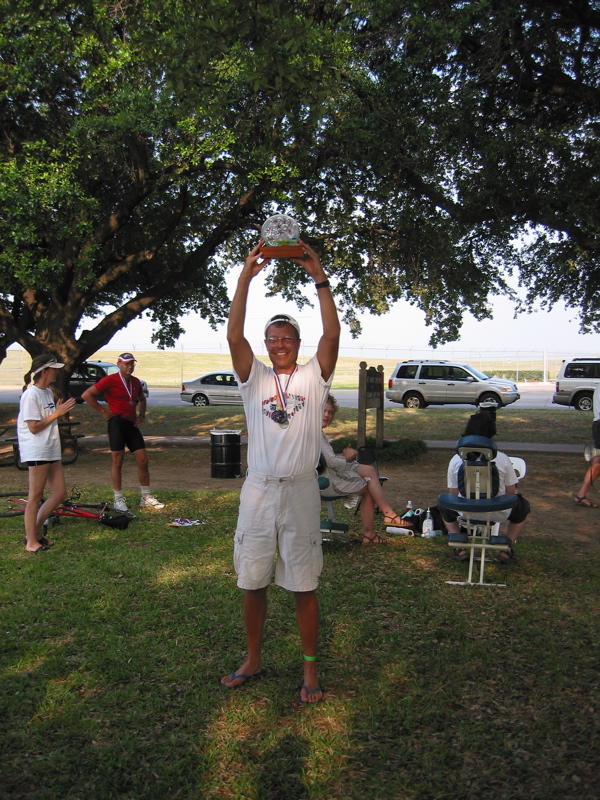
We had a great showing for the race, a lot of our crew came along, some of them for their first real regatta. I think everyone had a great time. Seven races was a little too much for me, but I had a great time and I was happy that I could do seven races and stay alive. I ended up with two silvers and a gold, Rachel ended up with five bronze and two silvers. Also, our team won the team trophy for the most medals won in the regatta. Paul, our president is holding it in the picture below.

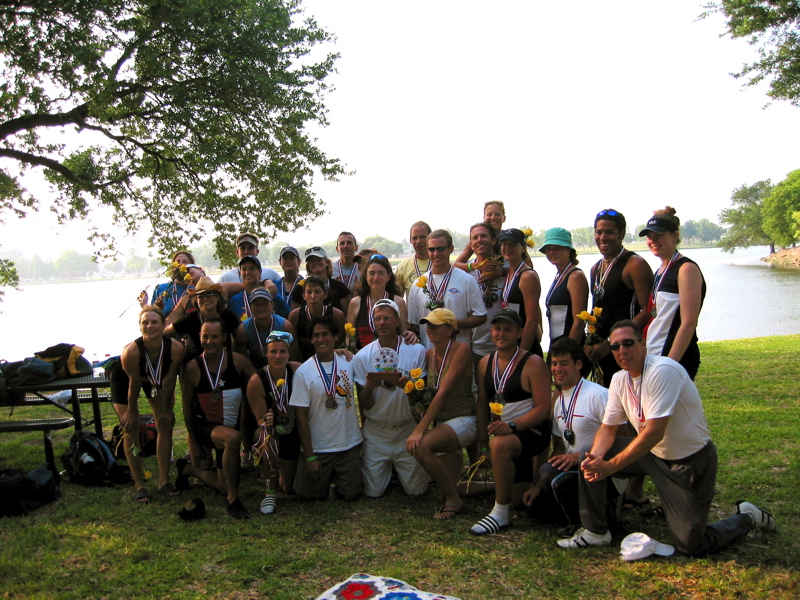
Also, here is a great picture of the whole team (minus our coach because he left before we took the picture):

I love regattas. They test your skill and strength, your resolve, your heart, and they bring a team together in the spirit of competition. I came away from this regatta feeling very proud to be a part of our team, and proud of my effort and results. I also came away with a clear picture of what I need to improve on, and I have been working on that. Much thanks to the DRC for hosting a great race, thanks to Rachel’s parents for hosting all 30 of us in their house, thanks to George, our coach, for all the brilliant training, and thanks to the team for putting it all out there. Our next regatta is the Master’s National competition in Worcester, MA at the beginning of August. We’re looking forward to that for sure!

No responses yet

May 13 2005

Introduction to rowing

Published by Ari under rowing

As many of you know, Rachel and I are avid rowers. Since many of the posts on this blog may be about rowing in the future, I’ve decided to write a little introduction to the technicalities of the sport so that you can better understand what I’m talking about when I write about rowing.

We row what are referred to as shells. There are many different kinds of boats needing from one to nine people to successfully row them, and there are two styles of rowing, sweep and sculling. In sweep rowing, each person in a boat requires only a single, large oar and the direction of the oars are placed so that each person rowing in the boat is rowing on the opposite side of the person in front of them. There are three major kinds of sweep boats that we row, a pair, a four, and an eight (denoted in rowing script 2-, 4-/+, 8+) What do the pluses mean? Many of the sweep style boat require an additional person in the boat in order to steer and direct it. This person is called a coxswain, or cox for short. The pluses after 4+ and 8+ mean that the shell has a place for, and requires a coxswain to function. A coxswain or cockswain was at first referred to as the swain (boy servant) in charge of the small cock or cockboat that was kept aboard for the ship’s captain and which was used to row him to and from the ship. The term has been in use in England dating back to at least 1463. With the passing of time the coxswain became the helmsman of any boat, regardless of size, including crew boats. The boats that are 2- and 4-, do not have a place for a coxswain, and are thus called a pair and a straight four. Here are the configurations of a 2-, 4+ and 8+:


These boats are very fun to row, and the pair is certainly one of the hardest boats to row, since two people, each with only one oar, can potentially pull the boat in circles if one is significantly stronger or rows longer than the other person. They need to be quite well matched.

In the other style of rowing, called sculling, each person has two, smaller oars. This arrangement allows for more efficient transfer of power to the water (meaning the boats are faster than their sweep equivalents), but the technique is more difficult to master, since you now have two oars to deal with. The types of boats in this category are a single, a double, a quad (denoted 1x, 2x, and 4x). None of these boats require a coxswain to steer them, mainly because the boats are too small for that. So, the person sitting in the bow seat, steers the boat with a cable that is attached to one of his feet which turns the rudder on the boat. This style of steering is usually only present in the 4x, and sometimes in the 2x if that boat can be converted to a 2-. Here are the configurations of a 1x, 2x, and 4x:


The single is perhaps the hardest boat out of all the styles to row. It is nice because it only needs one person to row it, but the boats generally weigh 18-20 or so pounds, are 15-20 feet long and are only 1 foot wide. My butt usually hangs over the side of the boat when I’m rowing it. So, it is really difficult to balance the boat and there is a lot less room for error in your rowing technique.

When looking at the pictures above, you might wonder which direction people sit. When you’re looking at the inside of a real boat, it is pretty easy to figure out because the foot stretchers (the place where you strap your feet in) are facing the right direction. In these boats, the people rowing face the stern, or the front of the boat, and they pull and propel the boat towards the bow (or rear) of the boat. So, yes, these boats are literally rowed backwards from normal boats. In fact, the rowers row with their backs facing the direction of motion the entire time. The person in the bow seat of a non-coxed boat must constantly look over their shoulders to make sure that the boat is on course and isn’t about to hit something. This person either has to steer with his/her foot, or tell the rest of the boat to put more pressure on one side or the other in order to steer it. This position in the boats is call the bow seat, or simply bow. The seats in any type of boats are numbered from the bow seat (which is number 1) to the stern-most seat, which can be anywhere from number 2 to number 8. The stern-most seat also has a special name and function, and is known as the stroke seat. The person in the stroke seat sets the pace for the entire boat. It is extremely important for the entire boat to row exactly alike. Everyone must put their oars into the water at the same time (called the catch in rowing), and everyone must take their oars out of the water at the same time (called the finish, or release). Also, they must keep their bodies perfectly centered and keep their oars at the same height on the recovery (when the oars are not in the water) and the same depth during the drive (when the oars are in the water). The stroke seat is the person in the front whom everyone must follow. If the stroke seat is not rowing in a very regular, easy to follow fashion, it will throw the whole boat out of sync. Naturally, if a person is rowing a single, that person functions as bow and stroke simultaneously, so it is a big job.

There are two sides to every boat, right and left. However, right and left are in the eye of the beholder, which is why each side was named either starboard or port, following traditional mariner terminology. Port and starboard are shipboard terms for left and right, respectively. Confusing those two could cause a ship wreck since two boats must pass on the starboard side of each other. In Old England, the starboard was the steering paddle or rudder, and ships were always steered from the right side on the back of the vessel. Larboard referred to the left side, the side on which the ship was loaded. So how did larboard become port? Shouted over the noise of the wind and the waves, larboard and starboard sounded too much alike. The word port means the opening in the “left” side of the ship from which cargo was unloaded. Sailors eventually started using the term to refer to that side of the ship. Use of the term “port” was officially adopted by the U.S. Navy by General Order, 18 February 1846 and has been adopted in all forms of recreational watercraft in the time since then. In a crew boat, if you are facing the stern (front), your left side is facing starboard, while your right side is facing port. The sides are reversed in normal boats that actually move in the direction of the stern. So in sweep rowing, you either have a starboard or a port oar. In sculling, you have both a starboard and a port oar. The person steering the boat, whether it be the bow seat or a coxswain, refers to these sides in order to control the boats and shout commands to everyone.

Anyway, Rachel and I are a part of the competitive teams at the Austin Rowing Club. Our goal is to train for competitions at the masters level, which is age 26 and above. There are basically two types of races, a sprint and a head race. A sprint can last for either 1000 or 2000 meters and a head race can last for 4500 – 6000 meters. Naturally, the strategies for each type of race are different, but they are all a lot of fun.

Rowing is extremely hard work and a very good type of exercise. I definitely recommend it to anyone who wants to try it. It is addicting the better at it you get and the more you start to see results from your hard work. The other aspect of rowing are the people. Pretty much everyone on our teams and the recreational teams are great people and a lot of fun. Rowing is a very social sport and the people reflect this aspect. It is a great stress reliever and something that I will hopefully continue to do for the rest of my life.

No responses yet